Importing goods into Thailand requires more than arranging transportation. Businesses also need to prepare shipping documents, customs-related information, product details, and supporting documents before the shipment arrives.
For importers, manufacturers, trading companies, and procurement teams, incomplete or inconsistent documents can lead to customs clearance delays, document corrections, additional coordination, or unexpected cost implications.
This checklist explains the key import documents businesses should prepare when shipping goods to Thailand. The actual document requirements may vary depending on the product type, HS Code, origin country, trade terms, and relevant regulations.
Why Import Documents Matter
Import documents are used to support customs declaration, cargo release, duty and tax calculation, shipment verification, and delivery planning.
If documents are missing, unclear, or inconsistent, the shipment may require additional review before customs clearance can proceed. In some cases, businesses may also need permits, certificates, or approvals from relevant authorities before the goods can be released.
For this reason, import document preparation should begin before the cargo is shipped, not after the cargo has already arrived in Thailand.
1. Commercial Invoice
The commercial invoice is one of the most important documents in an import shipment.
It provides key transaction details between the seller and the buyer, including product description, quantity, unit price, total value, currency, trade terms, seller information, buyer information, and invoice date.
Businesses should check that the commercial invoice includes:
- Seller name and address
- Buyer name and address
- Invoice number and date
- Product description
- Quantity
- Unit price
- Total value
- Currency
- Incoterms or trade terms
- Country of origin, if available
- Payment terms, if applicable
The product description should be clear enough for customs and logistics review. Vague terms such as “parts,” “equipment,” or “samples” may not be sufficient for import documentation.
2. Packing List
The packing list explains how the goods are packed and arranged for shipment.
It usually includes the number of packages, package type, gross weight, net weight, dimensions, and cargo details. This document helps customs, freight forwarders, warehouse teams, and transport providers verify the shipment against the physical cargo.
A packing list should usually include:
- Product description
- Number of cartons, pallets, crates, or packages
- Gross weight
- Net weight, if available
- Package dimensions
- Total volume
- Marks and numbers, if applicable
- Packaging type
The information on the packing list should match the commercial invoice and transport documents. Any mismatch in quantity, weight, or package count may create questions during customs clearance.
3. Bill of Lading or Air Waybill
The Bill of Lading or Air Waybill is the transport document issued for the shipment.
For sea freight, the Bill of Lading is commonly used. For air freight, the Air Waybill is used. These documents include transport details such as shipper, consignee, origin, destination, carrier information, cargo description, number of packages, and freight routing.
Businesses should review:
- Shipper and consignee details
- Notify party
- Port of loading or airport of departure
- Port of discharge or airport of arrival
- Cargo description
- Number of packages
- Gross weight
- Freight terms
- Vessel, flight, or carrier details
The transport document should be consistent with the commercial invoice and packing list.
4. Import Declaration
The import declaration is used for customs clearance and import reporting.
It contains shipment details, importer information, product classification, customs value, duty and tax information, and other customs-related data. In Thailand, import procedures generally involve customs entry submission with supporting documents.
Businesses should coordinate with the logistics provider or customs broker to confirm what information is required for the import declaration and whether the importer information is ready.
5. HS Code Information
The HS Code is used to classify goods for customs purposes. It may affect duty rates, taxes, import restrictions, permits, and supporting document requirements.
Businesses should prepare the HS Code if it is already confirmed. If the HS Code is not yet confirmed, the importer should prepare supporting product information for review.
Useful information may include:
- Product specification
- Catalogue
- Technical document
- Product photo
- Material details
- Intended use
- Model number
- Previous import records, if available
Businesses should avoid guessing the HS Code based only on a general product name. Incorrect classification may lead to customs review, document correction, or additional clarification.
6. Certificate of Origin
A Certificate of Origin may be required or useful depending on the shipment, trade agreement, product type, and buyer-seller arrangement.
This document confirms the origin of the goods. In some cases, it may support preferential tariff treatment under relevant trade agreements, subject to applicable rules and document requirements.
Businesses should check whether a Certificate of Origin is required before shipment and confirm which form or format is applicable.
7. Import License or Product Permit
Some products require import licenses, permits, certificates, or approval from relevant authorities before importation.
This may apply to certain goods such as food products, chemicals, cosmetics, medical-related products, electronics, controlled goods, machinery, or other regulated items.
The requirement depends on the product type, HS Code, destination regulations, and relevant government agencies.
Businesses should check permit requirements before the cargo is shipped. Waiting until the cargo arrives may create customs clearance delays and additional storage costs.
8. Insurance Document
If cargo insurance is arranged, the insurance document should be prepared and checked.
Insurance may be relevant for high-value goods, fragile cargo, machinery, long-distance shipments, or goods with higher transportation risk.
The insurance document may include:
- Insured value
- Cargo description
- Policy or certificate number
- Coverage period
- Origin and destination
- Insured party
Insurance requirements may also depend on Incoterms and buyer-seller agreement.
9. Product Specification or Technical Documents
Some products require more detailed supporting documents for review.
For example, machinery, electronics, chemicals, industrial parts, medical-related items, or controlled goods may require product specifications, catalogues, technical drawings, test reports, or material information.
These documents help clarify product classification, usage, material, and regulatory requirements.
Businesses should prepare technical documents when the product description alone is not enough.
10. Purchase Order or Sales Contract
A purchase order or sales contract may not be required for every shipment, but it can support transaction verification and commercial review.
It may help clarify:
- Buyer and seller relationship
- Product details
- Ordered quantity
- Price
- Payment terms
- Delivery terms
- Trade terms
If there is any question about the commercial transaction, supporting documents such as purchase orders or contracts may be useful.
11. Arrival Notice
An arrival notice is usually issued by the carrier, freight forwarder, or shipping agent when the cargo is approaching or has arrived at the destination.
It may include vessel or flight details, arrival date, shipment reference, container number, and destination handling information.
Businesses should review the arrival notice carefully and coordinate document submission before the cargo release process.
12. Power of Attorney or Authorization Documents
In some cases, the importer may need to authorize a customs broker, freight forwarder, or logistics representative to handle certain customs-related procedures on its behalf.
Authorization documents may be required depending on the arrangement and the process involved.
Businesses should confirm with the logistics provider whether any authorization documents are needed before customs clearance begins.
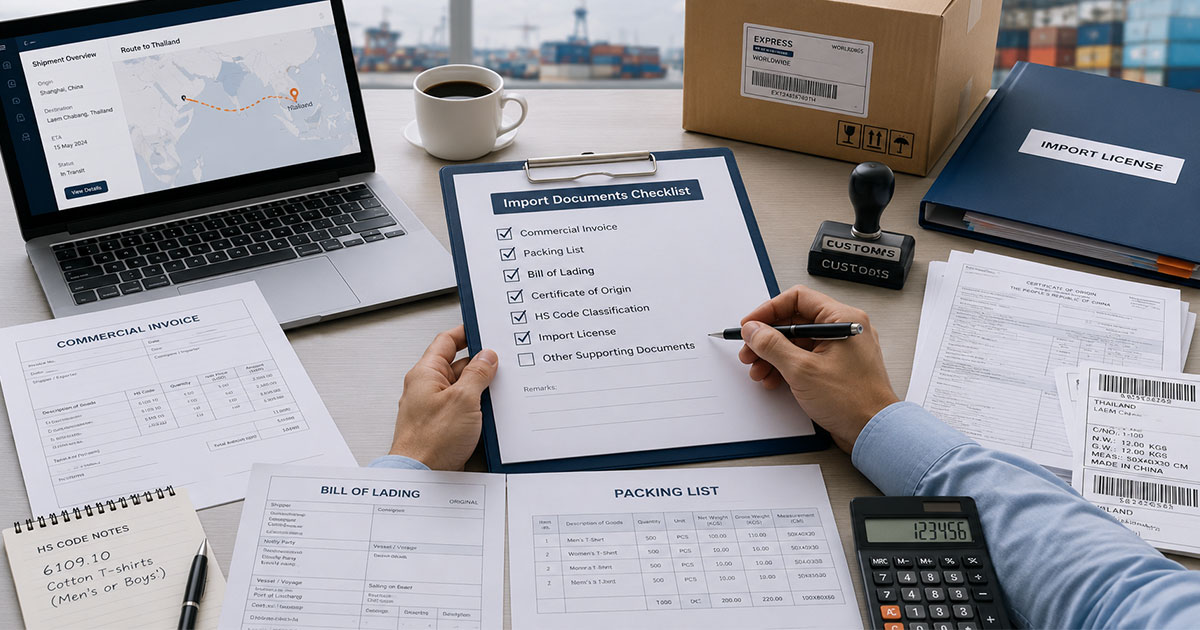
Import Documents Checklist
Before shipping goods to Thailand, businesses should review the following checklist:
- Commercial invoice
- Packing list
- Bill of Lading or Air Waybill
- Import declaration information
- HS Code information
- Certificate of Origin, if applicable
- Import license or product permit, if required
- Insurance document, if applicable
- Product specification or catalogue, if needed
- Purchase order or sales contract, if applicable
- Arrival notice
- Power of attorney or authorization documents, if required
- Importer information and tax details
- Cargo weight and dimensions
- Incoterms or trade terms
- Delivery address and contact person
This checklist should be adjusted based on the product type, shipment method, origin country, and import requirements.
Common Document Issues That Businesses Should Avoid
Many customs clearance issues are caused by document inconsistencies. Businesses should review documents carefully before shipment.
Common issues include:
- Product description not matching across documents
- Quantity mismatch
- Weight mismatch
- Incorrect consignee information
- Missing invoice value or currency
- Unclear Incoterms
- HS Code not confirmed
- Missing import permit
- Late document submission
- Documents not aligned with the actual cargo
A careful document review before shipment can help reduce avoidable customs clearance delays.
How BOP Express Supports Import Document Preparation
For businesses importing goods into Thailand, document preparation is an important part of logistics planning.
BOP Express supports business customers with freight forwarding coordination, customs clearance preparation, shipping document review, air freight, sea freight, cross-border logistics, and inland delivery planning based on shipment details provided.
By preparing import documents early, businesses can work more effectively with the logistics team and reduce avoidable documentation issues before the shipment arrives.
Talk to BOP Express
If your business is preparing to import goods into Thailand, contact BOP Express to discuss your shipment details, documents, route, and expected timeline.
Our team can help review the logistics requirements and support the planning process based on the information provided.