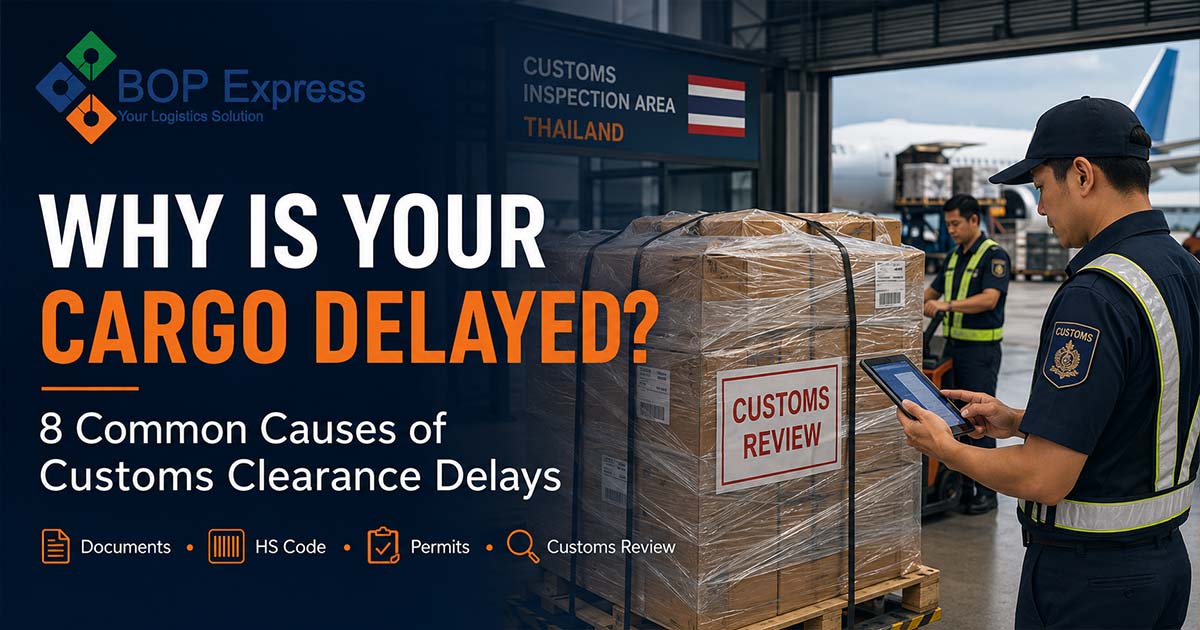
When an import shipment arrives in Thailand but cannot be released as expected, businesses often describe the situation simply as:
“The cargo is stuck at Customs.”
However, customs clearance delays can have many different causes.
The issue may originate from shipping documents, product information, tariff classification, import licences, customs valuation, discrepancies between documents, or requirements applying specifically to the imported goods.
For importers, manufacturers, trading companies, and procurement teams, understanding these potential issues before the shipment arrives can help reduce unnecessary delays and improve import planning.
What Does “Cargo Stuck at Customs” Actually Mean?
In practical terms, the phrase does not necessarily mean that Customs has seized or prohibited the shipment.
It often means that the cargo cannot proceed to release because an issue still needs to be resolved during the import clearance process.
Depending on the shipment, additional action may involve:
- correcting or providing documents
- confirming product information
- reviewing an HS Code
- providing an import licence or certificate
- clarifying customs value
- answering additional questions
- coordinating with another government agency
- arranging cargo inspection
The exact reason therefore needs to be identified before the appropriate solution can be determined.
1. Import Documents Are Incomplete
One of the most common areas that should be checked first is documentation.
Typical import documents may include:
- Commercial Invoice
- Packing List
- Bill of Lading or Air Waybill
- Certificate of Origin, when applicable
- import licence or certificate, when required
- other product-specific supporting documents
Missing documents can prevent the import declaration or cargo release process from proceeding normally.
This is why documents should preferably be reviewed before the shipment leaves the country of origin.
2. Information Between Documents Does Not Match
Having all required documents does not automatically mean the documentation is ready.
Information should also be consistent.
For example:
Commercial Invoice:
Product A — 500 units
Packing List:
Product A — 480 units
Or the product name shown on the Invoice may differ significantly from the cargo description on the transport document.
Other discrepancies may involve:
- quantity
- weight
- number of packages
- shipper or consignee
- cargo description
- country of origin
- invoice value
When information is inconsistent, clarification or document amendments may be required.
3. The Product Description Is Too General
Descriptions such as:
- Parts
- Accessories
- Samples
- Equipment
- Machine Parts
- Chemical
- Plastic Products
may not provide enough information to clearly identify what the product actually is.
A more specific product description can be important because customs classification, regulatory requirements, and supporting documents depend on the characteristics and intended use of the goods.
For example, instead of stating only:
“Machine Part”
information identifying the specific part, material, function, and machinery it is used with may help provide a clearer basis for classification and documentation.
4. The HS Code Needs Further Review
An HS Code is used to classify goods for customs purposes.
Classification can affect:
- customs duty
- import requirements
- licences or certificates
- statistical reporting
- other regulatory requirements
Selecting an HS Code solely because a supplier has used the same code previously can create risk.
The exporting country’s classification and the classification applied to importation into Thailand should not automatically be assumed to be identical in every case.
The actual nature, composition, function, and use of the goods should be considered when determining the appropriate classification.
5. The Goods Require a Licence or Certificate
Not every product can be imported using only standard shipping documents.
Certain categories of goods are controlled by law and may require licences, registrations, certificates, or approval from the responsible government agency.
Examples can include certain:
- food products
- medicines and cosmetics
- plants and agricultural products
- animals and animal products
- telecommunications equipment
- industrial products
- chemicals
- controlled equipment
The exact requirement depends on the product.
If a required permit has not been obtained, the shipment may not be able to proceed through normal clearance until the regulatory issue is resolved.
6. Customs Value Requires Clarification
Another potential issue concerns the value declared for customs purposes.
The Commercial Invoice is important, but determining customs value is not necessarily as simple as copying one figure from the invoice into the import declaration.
Depending on the transaction and applicable customs valuation rules, other elements may need to be considered.
Questions can arise when, for example:
- the declared price appears inconsistent with the transaction
- certain transportation or related costs need clarification
- the shipment is supplied free of charge
- goods are samples
- related companies are involved in the transaction
- discounts or special commercial arrangements apply
Importers should therefore keep transaction and supporting commercial information available.
7. Customs or Another Authority Requires Additional Review
Even when documentation has been prepared, some shipments may require further review.
This may include:
- document verification
- additional product information
- cargo inspection
- sampling
- confirmation of licences
- coordination with another government authority
The specific process depends on the type of cargo and applicable regulatory requirements.
An inspection does not automatically mean there is a violation. It may simply be part of the control procedure applying to that shipment.
8. The Problem Started Before the Cargo Reached Thailand
This is one of the most important points for importers.
Many customs clearance problems actually begin before the goods are shipped.
Examples include:
- purchasing goods without checking Thai import requirements
- allowing the supplier to select the HS Code without verification
- shipping before obtaining the required licence
- receiving documents only after cargo departure
- using unclear product descriptions
- discovering regulatory requirements only after the shipment arrives
Once the cargo has already arrived, the importer may have less flexibility and may also face additional logistics costs while waiting for the issue to be resolved.
What Are the Possible Consequences of Customs Clearance Delays?
A customs delay can affect more than the arrival date.
Depending on the shipment and transportation mode, possible consequences may include:
- storage charges
- container detention or demurrage
- warehouse charges
- document amendment fees
- additional transportation coordination
- production delays
- project delays
- inventory shortages
- disruption to customer delivery schedules
The commercial impact can therefore extend beyond the customs process itself.
How Can Importers Reduce the Risk?
There is no way to guarantee that every import shipment will clear without additional review.
However, businesses can reduce avoidable risks by preparing before shipment.
1. Identify the product clearly
Know exactly what is being imported, including:
- material
- function
- specification
- brand and model, where relevant
- intended use
2. Review the HS Code
Classification should be based on the actual product rather than relying solely on information supplied by the overseas seller.
3. Check regulatory requirements
Determine whether the goods require:
- an import licence
- registration
- certificate
- approval from another government agency
4. Review documents before departure
Commercial Invoice, Packing List, transport documents, permits, and supporting information should be reviewed for consistency where possible.
5. Estimate duties, taxes, and logistics costs
Import planning should consider the landed cost rather than only the supplier’s selling price.
6. Coordinate with logistics and customs specialists early
For unfamiliar, regulated, high-value, industrial, or complex cargo, early coordination can help identify issues before the shipment leaves origin.
Do Not Wait Until the Cargo Arrives to Think About Customs
A common misconception is that customs clearance starts only when the cargo reaches Thailand.
Operationally, the actual declaration and clearance may occur around arrival, but customs planning should begin much earlier.
Businesses should ideally review the shipment while the supplier is still preparing the goods.
This provides more time to resolve questions regarding documents, HS Codes, licences, transportation arrangements, and other import requirements.
BOP Express — Import and Customs Clearance Support
BOP Express supports businesses with international freight forwarding and customs clearance for shipments entering Thailand.
Our logistics scope includes coordination of:
- import shipment planning
- shipping documents
- customs clearance
- air freight
- sea freight
- cross-border logistics
- inland transportation
- cargo delivery
For businesses planning a new import shipment, reviewing the cargo and documentation before departure can help identify potential complications early.
If your company is preparing to import goods into Thailand, BOP Express can assist in reviewing the logistics and customs requirements relevant to the shipment before transportation begins.