Less than Container Load, or LCL, is a common sea freight option for businesses that do not need to use an entire shipping container.
One of its main advantages is flexibility. Instead of reserving a complete container, businesses can ship smaller cargo volumes by sharing container space with cargo from other shippers.
However, LCL pricing can sometimes appear more complicated than expected.
A quotation may include the ocean freight itself, origin handling, consolidation, destination handling, documentation, customs-related services, inland transportation, and other charges depending on the shipment.
For importers and exporters, understanding how these costs are structured is important when comparing quotations and estimating the total logistics cost.
This article explains how LCL shipping costs are commonly calculated, how cargo volume and weight affect pricing, and what additional charges businesses should check before confirming a shipment.
What Does LCL Mean?
LCL stands for Less than Container Load.
It is generally used when a shipment does not require an entire container. Cargo belonging to several shippers may be consolidated into one container at the origin and separated again after the container reaches its destination.
The shipper therefore does not normally pay for the use of an entire container in the same way as an FCL shipment.
Instead, the cost is commonly influenced by the amount of space and weight associated with the individual shipment, together with the handling and logistics services required at origin and destination.
This is why accurate dimensions and weight are particularly important when requesting an LCL quotation.
Businesses that are still deciding between shared container space and a dedicated container should first compare the operational differences between FCL and LCL shipping.
The Basic Concept: Weight or Measurement
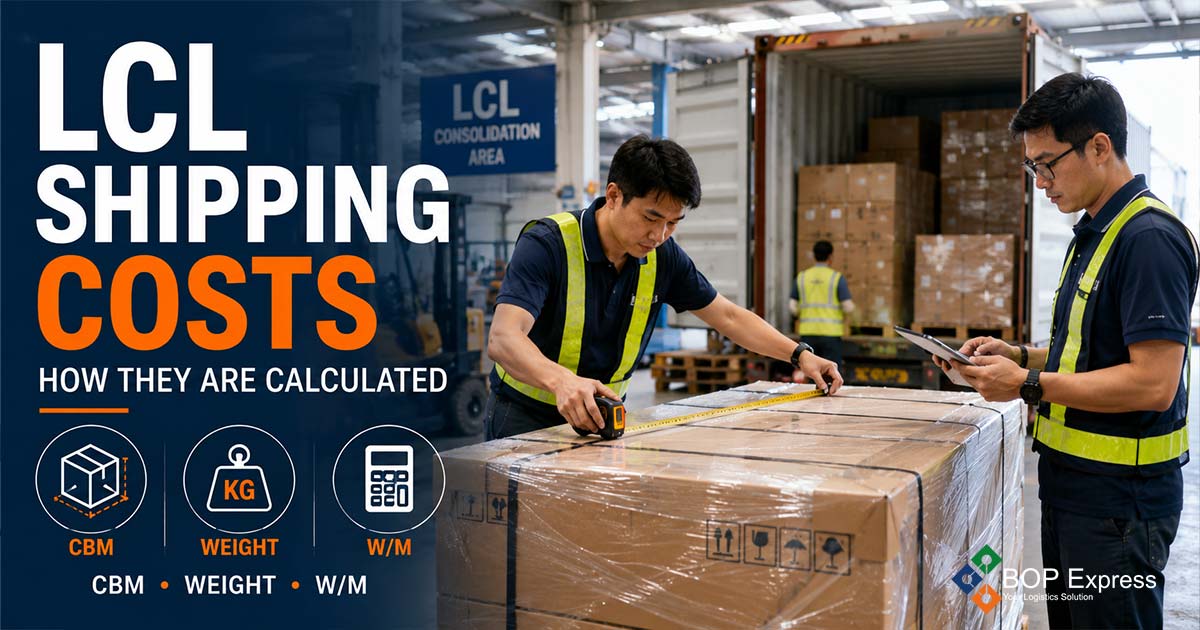
A common pricing basis used in LCL sea freight is known as Weight or Measurement, often written as W/M.
Under this approach, the shipment is assessed using:
- Cargo volume in cubic metres, or CBM
- Cargo weight in metric tonnes
The higher chargeable measurement is commonly used for the relevant freight calculation.
In a typical W/M comparison:
- 1 cubic metre represents 1 measurement unit
- 1 metric tonne represents 1 weight unit
The higher numerical value becomes the chargeable quantity for the rate that is quoted on a W/M basis.
However, businesses should always check the actual quotation conditions because minimum charges, rounding rules, service terms, and calculation methods can vary between providers and routes.
How Is Cargo Volume in CBM Calculated?
CBM means cubic metre.
For a rectangular carton, pallet, or crate, the basic calculation is:
Length × Width × Height = Volume
When measurements are given in metres, the result is expressed in cubic metres.
For example:
A wooden crate measures:
- Length: 1.20 m
- Width: 1.00 m
- Height: 1.50 m
The volume is:
1.20 × 1.00 × 1.50 = 1.80 CBM
If the shipment contains several identical packages, multiply the volume of one package by the number of packages.
For example, four packages measuring 0.50 CBM each would have a combined volume of:
0.50 × 4 = 2.00 CBM
Businesses should use the final external dimensions after packaging, including pallets, wooden crates, protective frames, and other materials.
The dimensions of the product itself may not represent the actual space the shipment occupies during transportation.
Example 1: Cargo Charged by Volume
Assume a shipment has:
- Volume: 3.20 CBM
- Gross weight: 1,100 kg
The weight is equivalent to approximately 1.10 metric tonnes.
The comparison is therefore:
- Measurement: 3.20
- Weight: 1.10
Under a standard W/M comparison, the chargeable quantity would normally be based on 3.20 W/M because the volume is the higher figure.
If the quoted ocean freight rate were expressed per W/M, that rate would then be applied to the chargeable measurement according to the provider’s quotation terms.
This example is intended only to explain the calculation concept. Actual rates and minimum charges vary by route and service.
Example 2: Dense Cargo Charged by Weight
Consider another shipment:
- Volume: 1.30 CBM
- Gross weight: 1,700 kg
The weight is approximately 1.70 metric tonnes.
The comparison becomes:
- Measurement: 1.30
- Weight: 1.70
In this example, the weight is higher, so the applicable chargeable quantity may be 1.70 W/M, subject to the quotation conditions.
This illustrates why businesses should always provide both dimensions and gross weight.
A shipment may occupy relatively little space but still be heavy enough for weight to affect the calculation.
Ocean Freight Is Only One Part of the LCL Cost
One of the most common misunderstandings about LCL is assuming that:
CBM × Ocean Freight Rate = Total Shipping Cost
In practice, an LCL shipment can involve several stages between the supplier and the final consignee.
Depending on the quotation and agreed service scope, costs may arise at the origin, during international transportation, and at the destination.
Businesses should therefore evaluate the entire quotation rather than only the ocean freight line.
Common Origin Charges in LCL Shipping
Before an LCL shipment enters the container, the cargo may need to be collected, received, checked, handled, and consolidated at the origin.
Potential origin-related charges can include:
- Cargo pickup
- Inland transportation
- Warehouse or CFS handling
- Consolidation charges
- Export documentation
- Customs clearance services
- Bill of Lading or documentation fees
- Handling charges
- Special cargo handling
- Other local charges applicable to the shipment
CFS generally refers to a Container Freight Station where LCL cargo can be received and consolidated.
The exact charges depend on the origin, service arrangement, Incoterms, cargo characteristics, and logistics provider.
Ocean Freight and Applicable Surcharges
The ocean freight component covers the international sea transportation portion of the shipment.
The rate may be quoted on a W/M basis.
Additional surcharges may also apply depending on the carrier, route, shipping period, operational conditions, or market situation.
These can change over time.
Businesses should therefore check:
- Rate validity
- Route
- Port of loading
- Port of discharge
- Sailing schedule
- Included charges
- Excluded charges
- Applicable surcharges
A quotation with a low base ocean freight rate should not automatically be considered the lowest-cost option until other charges have been reviewed.
Common Destination Charges
When the consolidated container reaches the destination, the cargo must normally be unloaded and separated before individual shipments can be released.
Depending on the service arrangement, destination costs may include:
- Destination CFS handling
- Deconsolidation charges
- Documentation
- Cargo release-related charges
- Customs clearance services
- Storage, if applicable
- Inland delivery
- Special handling
- Other destination local charges
These charges can be particularly important when comparing LCL quotations.
Two quotations with similar ocean freight rates may result in different total costs if their destination charge structures differ.
Businesses that want to understand where these charges occur can review the complete international sea freight process from cargo preparation through customs clearance and final delivery.
Why Minimum Charges Matter
Some LCL services apply minimum charges.
This means a very small shipment may still be charged at a minimum billable amount even if its actual volume is below that threshold.
For example, a shipment may occupy less than one cubic metre, but the quotation may still include a minimum freight or handling charge according to the provider’s tariff.
Minimums can also apply separately to different components of the quotation.
Businesses shipping very small quantities should therefore ask whether any minimum charges apply.
Stackable vs Non-Stackable Cargo
Stackability can also affect LCL planning and cost.
A stackable pallet allows other suitable cargo to be placed above it within the consolidation process.
A non-stackable shipment may occupy more usable container space than its physical CBM alone suggests because the space above the cargo cannot necessarily be used.
Non-stackable cargo may therefore require additional assessment or pricing depending on the provider and route.
Businesses should clearly state whether the cargo:
- Can be stacked
- Cannot be stacked
- Must remain upright
- Is fragile
- Has unusual dimensions
- Requires special lifting
This information should be provided before requesting a final quotation.
Special Cargo Can Change the Cost
Not every shipment can be treated as standard general cargo.
Additional requirements may apply to cargo such as:
- Dangerous goods
- Chemicals
- Batteries
- Liquids
- Temperature-sensitive cargo
- Fragile products
- High-value goods
- Oversized items
- Heavy cargo
- Non-stackable cargo
Depending on the product, special packaging, declarations, documentation, segregation, warehouse handling, or carrier approval may be required.
These requirements can affect both the available LCL service and its cost.
Businesses should therefore provide a clear cargo description instead of using broad terms such as “parts,” “equipment,” or “general cargo.”
How Incoterms Affect What Appears on the Quote
Incoterms help define the responsibilities of the buyer and seller during an international transaction.
They can influence which transportation and logistics costs are arranged or paid by each party.
For example, the quotation scope may differ depending on whether the shipment is arranged under EXW, FOB, CIF, DAP, or another agreed Incoterm.
This does not mean that Incoterms determine the carrier’s freight rate.
Rather, they help define which parts of the logistics chain are included within the responsibility of each party.
When requesting an LCL quotation, businesses should provide the agreed Incoterms whenever available.
Why Two LCL Quotations May Look Very Different
Businesses sometimes receive two LCL quotations for the same shipment and find that the numbers are difficult to compare.
One provider may show a low ocean freight rate but separate several local charges.
Another may bundle certain components.
The quotations may also have different assumptions regarding:
- Pickup
- CFS handling
- Customs clearance
- Documentation
- Destination charges
- Final delivery
- Surcharges
- Rate validity
- Cargo dimensions
- Cargo weight
The correct comparison should therefore be made on a similar service scope.
Businesses should ask:
What exactly is included from the point of origin to the point of delivery?
Comparing only one freight line can produce the wrong conclusion.
Why Accurate Dimensions Matter So Much
LCL pricing depends heavily on the physical characteristics of the shipment.
If a supplier initially estimates the cargo at 3 CBM but the final packed volume becomes 4.2 CBM, the transportation cost may change.
The same problem can occur when:
- A pallet is added
- Wooden crates are larger than expected
- Protective packaging increases dimensions
- The number of cartons changes
- Cargo becomes non-stackable
- Final gross weight differs from the estimate
Businesses should therefore request final packing information whenever possible before treating a freight quotation as the expected final cost.
Accurate cargo information affects not only LCL pricing but also shipment planning, handling requirements, customs preparation, and final delivery.
Information to Prepare Before Requesting an LCL Quote
For a more useful quotation, prepare:
- Product description
- Number of packages
- Packaging type
- Length, width, and height of each package
- Total CBM
- Gross weight
- Whether cargo is stackable
- Country and city of origin
- Port or location of destination
- Pickup address, if required
- Final delivery address, if required
- Cargo-ready date
- Incoterms
- Commercial value
- Commercial invoice, if available
- Packing list, if available
- Special handling information
- Customs clearance requirements
Accurate information helps the freight forwarder prepare a quotation based on the actual shipment rather than assumptions.
Should Businesses Choose LCL Based on Price Alone?
No.
LCL may be commercially suitable for smaller cargo volumes, but the decision should also consider:
- Total logistics cost
- Transit time
- Consolidation schedule
- Cargo handling
- Inventory requirements
- Delivery deadline
- Cargo characteristics
- Shipment frequency
As cargo volume increases, businesses should also compare LCL with FCL.
There is no universal CBM threshold at which FCL automatically becomes the better option for every route.
Actual quotations provide a more reliable comparison.
How a Freight Forwarder Can Help Review LCL Costs
A freight forwarder can help businesses understand the structure behind a quotation and identify which services are included.
The review can include:
- Cargo volume and W/M
- LCL freight
- Origin handling
- Consolidation
- Destination charges
- Customs coordination
- Inland transportation
- Special handling
- Shipping schedule
- Overall door-to-door cost
This is particularly useful when the business receives quotations that use different formats or service scopes.
BOP Express provides sea freight support for both FCL and LCL shipments together with related freight forwarding and logistics coordination.
The objective is not simply to identify the lowest individual rate, but to understand the expected logistics cost for the required shipment arrangement.
Conclusion
LCL shipping costs are influenced by more than the amount of container space used.
A common calculation basis considers Weight or Measurement (W/M), comparing cargo volume in CBM with cargo weight in metric tonnes.
However, the freight calculation is only one part of the total cost.
Businesses should also review:
- Origin charges
- Consolidation and CFS handling
- Ocean freight
- Applicable surcharges
- Destination and deconsolidation charges
- Customs-related services
- Inland transportation
- Storage or special handling where applicable
The most important step before requesting a quotation is to provide accurate cargo information.
Dimensions, gross weight, packaging, stackability, cargo description, origin, destination, Incoterms, and service scope can all affect the final quotation.
When comparing LCL rates, businesses should therefore look beyond a single price per CBM and compare the complete logistics arrangement from origin to destination.
For a shipment-specific LCL assessment, businesses can contact BOP Express with the cargo dimensions, gross weight, origin, destination, Incoterms, and cargo-ready date.
Frequently Asked Questions
Is LCL always charged by CBM?
Not always. LCL quotations commonly use a Weight or Measurement basis that compares cargo volume with cargo weight. The applicable method and minimum charges should be confirmed from the actual quotation.
What does W/M mean in LCL shipping?
W/M means Weight or Measurement. A shipment may be assessed by its volume in cubic metres or its weight in metric tonnes, with the higher chargeable measurement generally used according to the quotation terms.
Is ocean freight the total LCL cost?
Usually not. An LCL shipment may also involve origin handling, consolidation, documentation, destination handling, deconsolidation, customs services, inland transportation, and other applicable charges.
Why did my LCL price change after the cargo was packed?
The final dimensions, weight, packaging, or stackability may differ from the original estimate. Because these factors affect the chargeable measurement and handling requirements, the final cost can also change.
Should I compare LCL and FCL for larger shipments?
Yes. When cargo volume increases, businesses should consider obtaining both LCL and FCL quotations and compare the total cost, lead time, handling requirements, and service scope instead of relying on a fixed CBM rule.