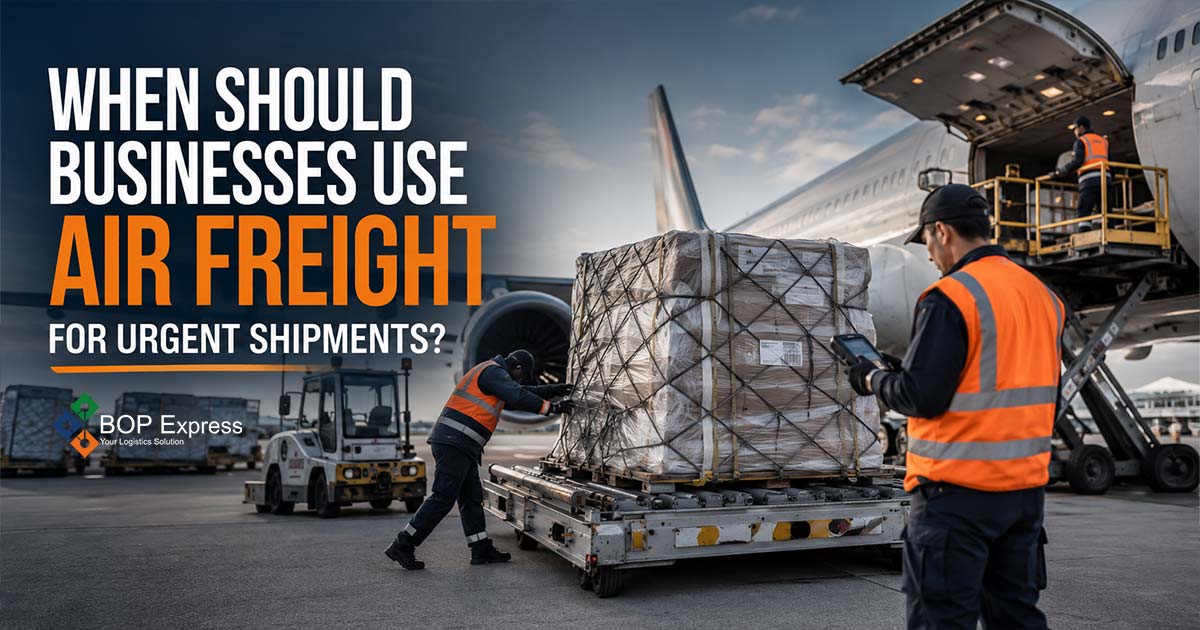
When an international shipment becomes urgent, air freight is often the first transportation option businesses consider. Compared with sea freight, air freight can significantly reduce the transportation time between countries. However, speed alone should not determine the shipping method.
Air freight usually involves a higher transportation cost and may be subject to specific cargo, packaging, documentation, airline, and airport-handling requirements. Businesses should therefore evaluate the operational impact of a late shipment, the characteristics of the cargo, the required delivery date, and the total logistics cost before making a decision.
In many cases, air freight is most appropriate when the cost of waiting is greater than the additional cost of faster transportation.
This article explains when businesses should consider air freight for urgent shipments, when another shipping method may be more suitable, and what information should be prepared before requesting a freight arrangement.
What Makes a Shipment Urgent?
Businesses that are still comparing transportation methods can review the differences between air and sea freight before deciding whether the additional speed is commercially necessary.
A shipment is not necessarily urgent simply because a business wants it to arrive quickly. From a logistics perspective, urgency usually exists when a delay could create a measurable operational or commercial consequence.
Examples may include:
- A factory waiting for a critical replacement part
- A production line at risk of stopping
- Inventory reaching a critically low level
- Goods required for a scheduled product launch
- Samples needed for customer approval
- Equipment required at a project site
- Replacement products needed to resolve a customer issue
- Time-sensitive goods with a limited usable or selling period
The required delivery date should be supported by a clear business reason. This allows the logistics team to compare the additional air freight cost with the potential cost of production downtime, lost sales, contractual consequences, or disruption to the supply chain.
Businesses should also distinguish between flight time and total door-to-door lead time. Cargo still needs to be collected, prepared, processed at the origin airport, transported by air, cleared through customs, and delivered from the destination airport.
An available flight does not automatically mean that the cargo can immediately depart or arrive at the consignee’s premises.
Situations Where Air Freight May Be the Right Choice
Preventing Production Interruptions
One of the clearest situations for using urgent air freight is when a factory requires components, tools, or spare parts to continue production.
A missing component may represent only a small part of the finished product, but its absence can affect an entire production schedule. In this situation, the value of the cargo may be lower than the cost of the air freight, yet shipping by air may still be commercially reasonable because it helps reduce the risk of extended production downtime.
Before arranging the shipment, businesses should confirm:
- The latest acceptable arrival date
- The quantity required to restart or maintain production
- Whether the full order is needed immediately
- Whether part of the shipment can travel by air and the remaining quantity by sea
- Whether import documentation and permits are ready
Splitting a shipment between air and sea can sometimes balance urgency and transportation cost. The critical quantity can be shipped by air, while the remaining cargo follows through the regular sea freight process.
Replenishing Critical Inventory
Air freight may also be appropriate when inventory levels fall unexpectedly and the business is at risk of running out of a key product or material.
This may happen because of:
- Demand exceeding the original forecast
- A supplier delivering later than expected
- A previous shipment being postponed
- Inaccurate inventory planning
- Seasonal demand
- An unexpected customer order
Before moving the entire replenishment order by air, businesses should calculate the minimum quantity required to maintain operations or sales until the regular shipment arrives.
Using air freight only for the immediate requirement may help limit logistics costs while reducing the risk of a stockout.
Meeting Product Launch or Project Deadlines
Some cargo is connected to a fixed commercial or operational date. Examples include products for a market launch, materials for an exhibition, equipment for an installation, and components required at a construction or industrial project site.
When a deadline cannot easily be moved, air freight may provide a more suitable transportation option than sea freight.
However, businesses should not evaluate only the scheduled flight. They should also confirm:
- Cargo readiness at the supplier’s location
- Airport handling cut-off times
- Available flight capacity
- Transit arrangements
- Customs documentation
- Import licences or other approvals
- Delivery arrangements after arrival
A shipment may arrive at the destination airport on time but still miss the final deadline if customs clearance or inland transportation has not been coordinated.
Shipping High-Value or Time-Sensitive Goods
Air freight is frequently considered for cargo with a high value relative to its size or weight. This may include electronic components, specialised equipment, precision parts, medical-related supplies, and other commercially sensitive products.
Some goods may also have a limited selling period, usable period, or required delivery window. For these shipments, a shorter transportation time may help reduce inventory exposure and support faster distribution.
However, high-value cargo may require additional security arrangements, insurance consideration, specialised packaging, or controlled handling. These requirements should be discussed before the shipment is confirmed.
Businesses should not assume that every high-value or sensitive product can be accepted as standard air cargo.
Sending Samples and Replacement Items
Product samples, prototypes, test materials, and replacement items are often shipped in relatively small quantities but may have a high level of urgency.
A sample may be needed for:
- Product approval
- Laboratory testing
- Quality inspection
- Customer evaluation
- Packaging confirmation
- Pre-production review
Similarly, a replacement item may be required to resolve a warranty, maintenance, or customer service issue.
Because these shipments are usually smaller than a regular commercial order, air freight or an appropriate express transportation service may be more practical. The correct option depends on the cargo dimensions, weight, value, destination, customs requirements, and required delivery date.
When Air Freight May Not Be Suitable
Air freight is not automatically the right solution for every urgent request.
It may be less suitable when:
- The cargo is very large or heavy compared with its commercial value
- The shipment does not have a genuine delivery deadline
- The goods can be consolidated with an upcoming sea shipment
- The cargo is restricted or requires special airline approval
- The packaging is not suitable for air transportation
- Important commercial or customs documents are incomplete
- The destination has limited flight capacity or handling options
- The final delivery location is far from the destination airport
- The additional transportation cost is greater than the operational impact of waiting
Certain products, including some chemicals, batteries, liquids, temperature-sensitive items, and other regulated cargo, may require specific declarations, packaging, labels, documents, or carrier acceptance.
Cargo details should be checked before confirming the transportation plan. Businesses should avoid sending incomplete cargo descriptions or assuming that a product can be transported by air without verification.
For larger, non-urgent, or lower-value shipments, sea freight may remain the more commercially appropriate option.
Factors to Evaluate Before Choosing Air Freight
1. Required Delivery Date
Businesses should identify the latest acceptable delivery date rather than simply requesting the fastest available option.
The required date should include time for:
- Supplier preparation
- Cargo collection
- Export procedures
- Airport handling
- Flight transit
- Customs clearance
- Destination delivery
This provides a more realistic basis for selecting a route and service level.
2. Total Cost of Delay
The air freight rate should be compared with the potential financial and operational impact of a delayed shipment.
The cost of waiting may include:
- Production downtime
- Lost sales
- Overtime or rescheduling
- Customer service issues
- Project delays
- Storage or equipment standby costs
- Additional emergency purchasing
The decision should be based on total business impact, not transportation cost alone.
3. Cargo Size and Chargeable Weight
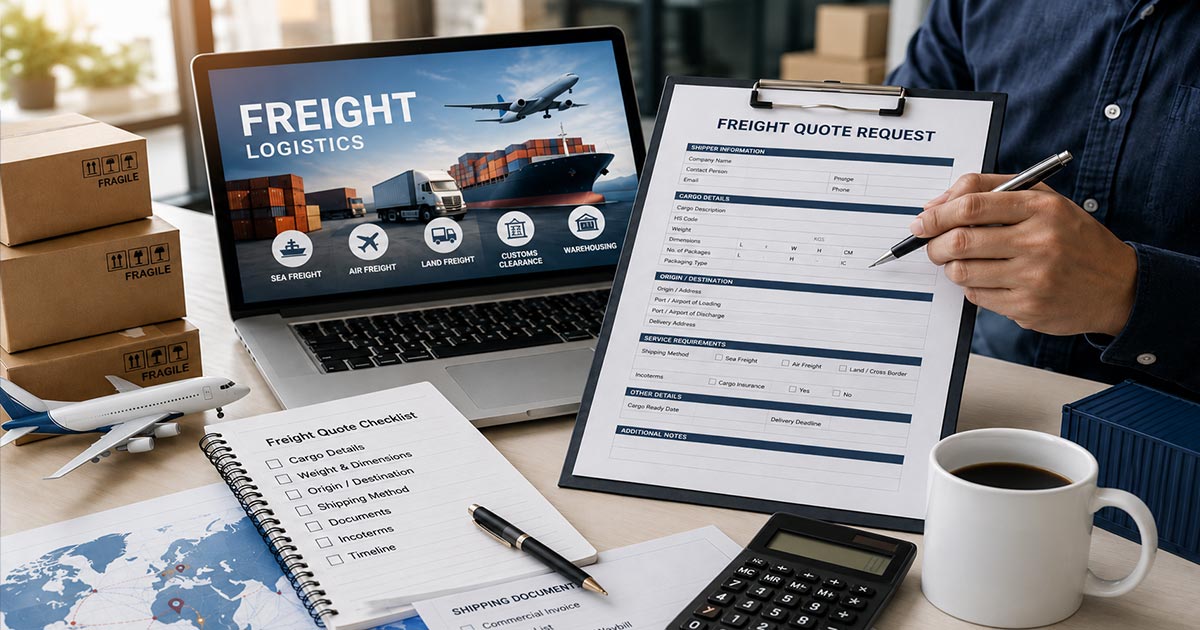
Accurate dimensions, weight, cargo descriptions, and delivery requirements are also essential when preparing information for a freight quotation.
Air freight charges are generally affected by chargeable weight, which may be based on the actual weight or the space occupied by the cargo.
Large but lightweight cargo can therefore cost more than expected because of its volumetric size.
Businesses should provide accurate:
- Number of packages
- Gross weight
- Package dimensions
- Packaging type
- Stackability information
Estimated or incomplete dimensions can result in an inaccurate quotation and may affect the final transportation arrangement.
4. Cargo Type and Handling Requirements
Providing complete cargo information helps the freight forwarder assess handling requirements, available transportation options, and potential restrictions before booking.
The cargo description must be specific enough for the freight forwarder and carrier to determine whether standard or special handling is required.
Important details may include:
- Product name and intended use
- Material or composition
- Battery content
- Liquid or chemical content
- Temperature requirements
- Fragility
- Commercial value
- Country of origin
- Relevant safety documentation
Descriptions such as “parts,” “equipment,” “sample,” or “general cargo” may not provide enough information for proper assessment.
5. Customs and Regulatory Readiness
Importers should prepare their commercial and supporting documents before departure, particularly when the shipment is connected to a fixed delivery deadline.
A fast flight cannot compensate for incomplete import or export documentation.
Businesses should confirm whether the shipment requires:
- Commercial invoice
- Packing list
- Air waybill information
- Certificate of origin
- Import or export licence
- Product registration
- Safety data
- Technical documentation
- Other supporting documents requested by customs or relevant authorities
Requirements vary according to the product, origin, destination, and applicable regulations. They should be reviewed before cargo departure whenever possible.
6. Origin and Destination Coordination
Urgent shipments require coordination across the entire route.
The supplier, shipper, consignee, freight forwarder, customs representative, and delivery team should have consistent information about:
- Cargo readiness
- Collection address
- Contact persons
- Required delivery date
- Customs documentation
- Delivery location
- Receiving hours
- Special handling instructions
A breakdown at any stage can reduce the time advantage gained from air transportation.
Information Businesses Should Prepare
To obtain a more accurate air freight assessment, businesses should prepare the following information:
- Origin and destination
- Collection and final delivery addresses, if required
- Product description
- Number and type of packages
- Gross weight
- Dimensions of each package
- Commercial value
- Country of origin
- Required delivery date
- Cargo-ready date
- Importer and consignee information
- Incoterms, where applicable
- Available invoice and packing list
- Information about batteries, chemicals, liquids, temperature control, or other special characteristics
- Required customs clearance or inland delivery services
The earlier this information is available, the more effectively the logistics provider can review possible routes, capacity, handling requirements, and documentation risks.
How a Freight Forwarder Supports Urgent Air Shipments
Businesses can review BOP Express’s logistics service overview for information about freight forwarding, customs coordination, and international cargo transportation.
A freight forwarder coordinates the different activities required to move cargo from the origin to the destination.
For an urgent air shipment, this may include:
- Reviewing cargo information
- Identifying suitable routing options
- Checking available capacity
- Coordinating collection
- Confirming packaging and handling requirements
- Preparing transportation documents
- Supporting export and import coordination
- Monitoring the shipment
- Arranging destination delivery
The freight forwarder cannot eliminate every operational, customs, airline, weather, or capacity-related risk. However, complete cargo information and early coordination can help identify potential issues before the shipment moves.
Businesses should communicate the actual required delivery date and operational consequences clearly. Simply marking a shipment as “urgent” does not provide enough information for effective planning.
Conclusion
Air freight can be an appropriate solution when a shipment is linked to production continuity, critical inventory, a fixed project deadline, product approval, or another time-sensitive business requirement.
The decision should not be based on speed alone.
Businesses should evaluate:
- The operational cost of waiting
- The minimum quantity that must arrive urgently
- The size and characteristics of the cargo
- Customs and regulatory readiness
- Available routing and capacity
- The complete door-to-door lead time
- The total logistics cost
For some shipments, moving a limited quantity by air and the remaining cargo by sea may provide a practical balance between urgency and cost.
Before confirming an urgent shipment, businesses should provide accurate cargo details and discuss the required delivery date, handling conditions, documentation, customs clearance, and destination delivery arrangements with their logistics provider.
For a shipment-specific assessment, businesses can contact BOP Express with the cargo details, origin, destination, required delivery date, and available commercial documents.
Frequently Asked Questions
Is air freight always the fastest international shipping method?
Air freight generally offers a shorter transportation time than sea freight. However, the complete lead time also depends on cargo readiness, collection, airport handling, flight schedules, customs clearance, and final delivery.
Should the entire urgent order be shipped by air?
Not necessarily. A business may ship only the quantity required to prevent a stockout or production interruption by air and transport the remaining quantity by sea.
Can every type of cargo be transported by air?
No. Some cargo may be restricted or require special packaging, documents, declarations, labels, handling, or airline approval. The cargo details should be reviewed before booking.
Why are accurate dimensions important for an air freight quotation?
Air freight pricing may be based on actual weight or volumetric size. Incorrect package dimensions can affect the quoted chargeable weight and the final transportation cost.
What documents are normally required for an urgent air shipment?
Common documents may include a commercial invoice, packing list, and transportation information. Additional documents can be required depending on the product, origin, destination, and applicable import-export regulations.