International cargo transportation involves much more than moving goods from one airport or seaport to another.
Before the main international freight movement begins, the cargo may need to be collected from a supplier, transported to a warehouse or terminal, prepared for export, and cleared through customs. At the destination, the shipment may need import customs clearance, cargo release, inland transportation, and final delivery to a warehouse, factory, project site, or other receiving location.
For businesses that want these stages coordinated as one logistics arrangement, door-to-door logistics can be a practical approach.
However, the term “door-to-door” should not automatically be interpreted as meaning that every possible cost, customs requirement, tax, inspection, or additional charge is included.
The actual scope depends on the freight quotation, Incoterms, origin and destination, cargo characteristics, customs requirements, and the services agreed between the parties.
This article explains what door-to-door logistics usually involves, which stages businesses should understand, and what should be checked before confirming a shipment.
What Is Door-to-Door Logistics?
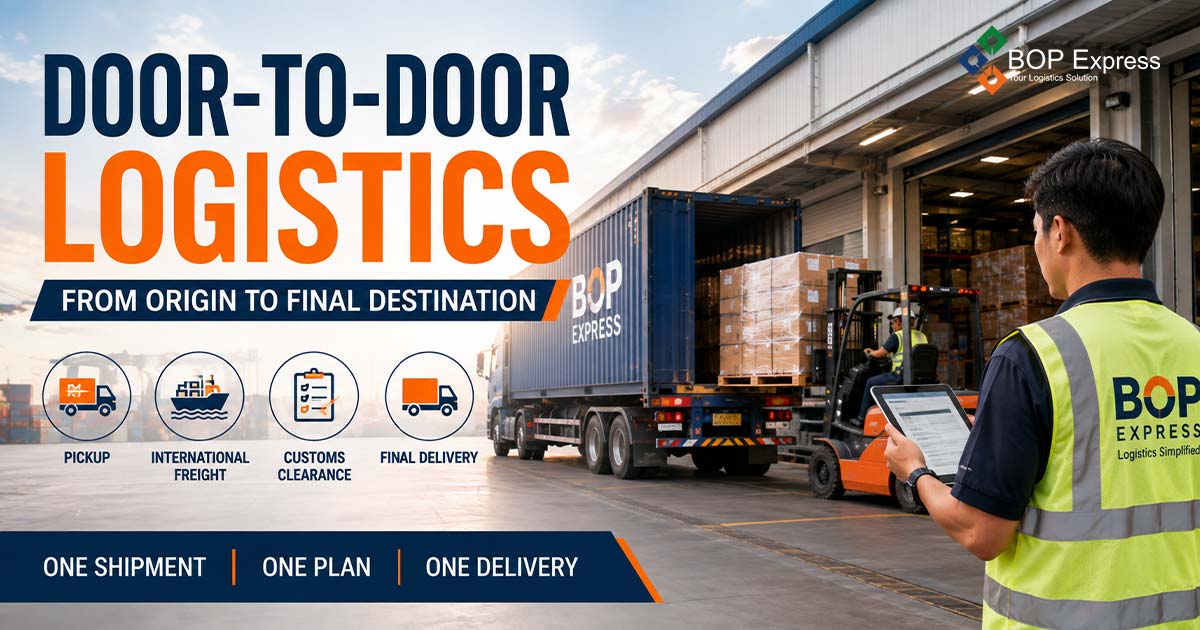
Door-to-door logistics generally refers to a transportation arrangement in which cargo is coordinated from an agreed pickup location at the origin to an agreed delivery location at the destination.
For an international shipment, the logistics chain may include:
- Pickup from the supplier or shipper
- Inland transportation at origin
- Origin warehouse or terminal handling
- Export customs clearance
- International air, sea, or cross-border transportation
- Destination handling
- Import customs clearance
- Cargo release
- Inland transportation at destination
- Final delivery to the consignee
The exact combination depends on the shipment and the agreed service scope.
For example, one door-to-door shipment may move from a supplier’s factory in another country directly to an importer’s warehouse in Thailand.
Another may begin at an exporter’s warehouse in Thailand and end at a customer’s distribution centre overseas.
The important point is that door-to-door describes the transportation scope between two agreed locations, not a universal package with identical inclusions for every shipment.
Door-to-Door Does Not Mean One Transportation Mode
Door-to-door logistics can involve several transportation modes.
A shipment may include:
Truck → Sea Freight → Truck
or:
Truck → Air Freight → Truck
A regional shipment may use:
Truck → Cross-border Customs Process → Truck
Some logistics movements may also involve warehousing, consolidation, transshipment, or multiple delivery points.
Therefore, door-to-door is better understood as a coordinated logistics chain rather than a single transportation method.
The international freight mode is only one part of the complete movement.
Step 1: Cargo Pickup at Origin
The process normally begins at an agreed pickup point.
This could be:
- Supplier factory
- Manufacturer
- Warehouse
- Distribution centre
- Consolidation warehouse
- Project site
Before pickup, the logistics provider may need information such as:
- Pickup address
- Contact person
- Cargo-ready date
- Number of packages
- Gross weight
- Package dimensions
- Cargo type
- Loading requirements
- Vehicle access
- Receiving or collection hours
Incorrect pickup information can create problems before international transportation even begins.
For example, a vehicle may arrive but be unsuitable for the cargo dimensions, or the supplier may not have completed export packing.
Businesses should confirm cargo readiness before arranging collection.
Step 2: Origin Inland Transportation
After collection, cargo may need to move to a port, airport, Container Freight Station, warehouse, or another logistics facility.
This stage is often referred to as origin inland transportation or pre-carriage.
The appropriate vehicle depends on:
- Cargo dimensions
- Weight
- Container type
- Loading method
- Route conditions
- Delivery schedule
- Special handling requirements
For containerised sea freight, the process can also involve container pickup, stuffing, weighing, terminal delivery, and container-related operating requirements.
For LCL cargo, the goods may be transported to a consolidation warehouse before being loaded into a shared container.
Step 3: Export Customs and Origin Handling
Before cargo leaves the exporting country, export procedures may need to be completed.
The documents and processes vary according to the origin country and product.
Common documentation may include:
- Commercial Invoice
- Packing List
- Export Declaration
- Bill of Lading or Air Waybill information
- Export licence, if required
- Certificate or product-specific documentation
- Other supporting documents required by authorities
The cargo may also pass through warehouse, terminal, port, or airport handling before departure.
Door-to-door coordination can help connect these activities, but businesses must still provide accurate product and commercial information.
A logistics provider cannot prepare correct customs information if the underlying cargo details are incomplete.
Step 4: International Freight Transportation
The main international transportation may be by:
- Sea freight
- Air freight
- Cross-border road transportation
- Multimodal logistics
The appropriate mode depends on factors such as:
- Required delivery date
- Cargo volume
- Weight
- Cargo value
- Product type
- Origin and destination
- Transportation cost
- Handling requirements
- Supply chain priorities
For sea freight, businesses may also need to choose between FCL and LCL depending on shipment volume and operational requirements.
The main freight movement should therefore be selected as part of the overall logistics plan rather than considered separately from pickup, customs, and final delivery.
Businesses using sea freight can also review the complete import-export process from cargo preparation and freight booking through customs clearance and final inland delivery.
Step 5: Arrival and Destination Handling
When the cargo reaches the destination country, it does not normally move directly from the vessel or aircraft to the consignee.
The shipment may first require:
- Unloading
- Terminal handling
- Warehouse or CFS handling
- Deconsolidation for LCL cargo
- Arrival documentation
- Delivery Order or cargo release procedures
- Coordination with the carrier or local agent
The actual process differs between air freight, FCL, LCL, cross-border cargo, and other shipment types.
Destination handling should therefore be considered when estimating the complete door-to-door lead time.
Step 6: Import Customs Clearance
Import customs clearance is one of the most important stages in an international door-to-door shipment.
Depending on the destination and product, businesses may need:
- Import Declaration
- Commercial Invoice
- Packing List
- Bill of Lading or Air Waybill
- HS Code information
- Certificate of Origin
- Import licence
- Product registration or approval
- Technical documentation
- Other supporting documents
Import duties, taxes, and regulatory requirements may also apply.
Businesses importing goods into Thailand should prepare the required import documents before cargo arrival whenever possible, particularly when licences, certificates, or product-specific information may be required.
A door-to-door transportation quotation does not automatically mean that all duties and taxes are included.
Businesses should confirm separately:
- Who is responsible for customs clearance
- Who pays duties and taxes
- Whether customs brokerage is included
- Whether permits have been checked
- Whether additional inspection costs are included or excluded
This should be clarified before shipment departure whenever possible.
Step 7: Cargo Release
After customs clearance and other required procedures are completed, the cargo can proceed toward release.
The exact release process depends on the transportation mode.
It may involve:
- Customs release
- Carrier release
- Terminal release
- Delivery Order
- Warehouse release
- Payment of applicable charges
If documents, payments, or permits are incomplete, cargo may remain at the port, airport, terminal, or warehouse.
This can affect both the delivery schedule and total logistics cost.
Step 8: Inland Transportation to the Final Destination
After cargo release, the shipment moves from the port, airport, terminal, border point, or warehouse to the agreed final destination.
This may be:
- Importer warehouse
- Factory
- Distribution centre
- Retail facility
- Construction site
- Industrial project site
- Customer location
The required vehicle should be selected according to cargo characteristics and receiving conditions.
Businesses should provide:
- Final delivery address
- Contact person
- Receiving hours
- Vehicle restrictions
- Loading or unloading requirements
- Equipment requirements
- Delivery appointment information
A shipment can arrive in the destination country on time but still experience final delivery delays if inland transportation has not been planned properly.
What Is Usually Included in a Door-to-Door Quote?
There is no universal list that applies to every provider.
Depending on the agreed scope, a quotation may include:
- Origin pickup
- Origin trucking
- Export handling
- Export customs clearance
- International freight
- Destination handling
- Import customs clearance
- Destination trucking
- Final delivery
But some charges may be excluded or quoted separately.
Businesses should never assume that the phrase “door-to-door” alone defines every cost.
The quotation should be reviewed line by line.
For LCL shipments in particular, businesses should also understand how freight, origin handling, consolidation, destination charges, and other cost components can affect the total quotation.
What May Not Be Included?
Depending on the quotation, possible exclusions may include:
- Import duties
- Taxes
- Import licences
- Government fees
- Customs inspections
- Physical examinations
- Storage
- Demurrage
- Detention
- Additional warehouse handling
- Waiting time
- Unplanned delivery attempts
- Special lifting equipment
- Insurance
- Dangerous goods surcharges
- Temperature-control requirements
- Other costs arising from unexpected shipment conditions
Not every shipment will incur these costs.
The purpose of checking them in advance is to understand which party will be responsible if they occur.
How Incoterms Affect Door-to-Door Logistics
Incoterms and door-to-door logistics are related but they are not the same thing.
Incoterms define agreed responsibilities between the buyer and seller for different parts of an international trade transaction.
Door-to-door describes the logistics service scope between agreed pickup and delivery points.
For example, the freight forwarder may be asked to arrange transportation from the supplier to the buyer’s warehouse, while the commercial transaction between the buyer and seller follows a particular Incoterm.
Businesses should therefore inform the logistics provider of the agreed Incoterms.
This helps clarify:
- Where the transportation responsibility begins
- Which party arranges each logistics stage
- Which costs are expected to be paid by the buyer or seller
- Where risk transfers under the commercial agreement
However, businesses should still review the actual freight quotation because the quotation and the sales contract serve different purposes.
Door-to-Door vs Port-to-Port
Port-to-port or airport-to-airport services usually cover a more limited part of the logistics chain.
For example:
Port-to-Port
Port of loading → International sea freight → Port of discharge
While door-to-door may include:
Supplier → Origin transport → Export process → International freight → Import process → Destination transport → Consignee
The broader scope can reduce the number of separate logistics providers the business needs to coordinate.
However, it also makes it more important to define exactly where the service begins and ends.
Why Door-to-Door Lead Time Is Different from Freight Transit Time
A common mistake is to use vessel or flight transit time as the expected delivery time.
Door-to-door lead time can also include:
- Supplier preparation
- Pickup
- Export handling
- Customs procedures
- Waiting for vessel or flight departure
- International transit
- Destination handling
- Import customs clearance
- Cargo release
- Inland transportation
- Delivery appointment
Therefore:
Freight Transit Time ≠ Door-to-Door Lead Time
When planning inventory or customer delivery commitments, businesses should ask for an estimated overall logistics timeline rather than looking only at the sailing or flight duration.
What Information Should Businesses Prepare?
To plan a door-to-door shipment, prepare:
- Pickup country and address
- Final delivery country and address
- Product description
- Number of packages
- Gross weight
- Package dimensions
- Packaging type
- Cargo-ready date
- Required delivery date
- Commercial value
- Country of origin
- Incoterms
- Shipper information
- Consignee information
- Commercial Invoice
- Packing List
- HS Code information, if confirmed
- Import or export permits, if applicable
- Special cargo characteristics
- Loading and unloading requirements
- Customs clearance requirements
- Insurance requirements, if applicable
The earlier this information is available, the easier it becomes to identify the appropriate transportation route and potential operational risks.
Common Mistakes When Requesting Door-to-Door Logistics
Assuming Everything Is Included
Always check the quotation scope.
Giving Only Port or Airport Information
Door-to-door planning requires actual pickup and final delivery locations.
Providing Estimated Cargo Dimensions Only
Final packaging can change the vehicle, freight, and handling requirements.
Ignoring Customs Requirements Until Arrival
Permits and supporting documents should be reviewed before shipping whenever possible.
Looking Only at International Transit Time
Pickup, customs, handling, and final delivery also affect the schedule.
Not Providing Incoterms
Without the commercial terms, responsibility between buyer and seller may be unclear.
When Can Door-to-Door Logistics Be Useful?
Door-to-door coordination can be useful for businesses that:
- Do not have an overseas logistics team
- Work with suppliers in multiple countries
- Need coordinated customs and transportation
- Import machinery or industrial goods
- Ship regular commercial cargo
- Want better visibility over the complete route
- Prefer to coordinate fewer logistics parties
- Need delivery to a factory, warehouse, or project site
It can also be useful when businesses want to evaluate the complete logistics cost rather than separately managing international freight and destination transportation.
However, the appropriate structure should always be based on the actual shipment.
What Should Businesses Check Before Confirming a Door-to-Door Quote?
Before confirming, ask:
- Where does the quoted service start?
- Where does it end?
- Is origin pickup included?
- Is export customs clearance included?
- Which international freight mode is included?
- Are origin and destination handling charges included?
- Is import customs clearance included?
- Are duties and taxes included or excluded?
- Is final inland delivery included?
- Are there any minimum or local charges?
- What charges may arise if customs inspection occurs?
- What happens if cargo is delayed or stored?
- Is cargo insurance included?
- What is the quotation validity?
- What is the expected door-to-door lead time?
A quotation that answers these questions clearly is easier to evaluate than one that shows only a single freight rate.
How a Freight Forwarder Supports Door-to-Door Logistics
A freight forwarder can coordinate several parties across the logistics chain.
Businesses can review BOP Express’s logistics services for sea freight, air freight, customs clearance, cross-border transportation, and origin-to-destination cargo coordination.
Depending on the shipment scope, this may include:
- Supplier coordination
- Cargo pickup
- Inland transportation
- Booking freight space
- Origin handling
- Export customs coordination
- Air or sea freight
- Overseas agent coordination
- Import customs clearance
- Cargo release
- Destination trucking
- Final delivery monitoring
The objective is not to eliminate every possible disruption.
Customs inspections, weather, capacity, port conditions, documentation issues, and other external factors can still affect a shipment.
However, having the different stages coordinated under a defined logistics plan can help businesses understand responsibilities, timelines, and potential issues more clearly.
Conclusion
Door-to-door logistics is not simply international freight with final delivery added at the end.
It is the coordination of several stages from an agreed origin location to an agreed final destination.
These stages may include:
- Pickup
- Origin inland transportation
- Export procedures
- International freight
- Destination handling
- Import customs clearance
- Cargo release
- Inland transportation
- Final delivery
The most important point for businesses is to understand the actual service scope.
“Door-to-door” does not automatically mean that duties, taxes, inspections, storage, insurance, permits, and every possible additional charge are included.
Before confirming a shipment, businesses should review the quotation, Incoterms, customs responsibilities, cargo information, delivery requirements, exclusions, and expected door-to-door lead time.
A clearly defined scope makes it easier to compare logistics quotations and plan the complete import-export process.
For a shipment-specific door-to-door assessment, businesses can contact BOP Express with the pickup location, final delivery address, cargo details, Incoterms, cargo-ready date, and customs requirements.
Frequently Asked Questions
Does door-to-door shipping include customs clearance?
It can, but this depends on the quotation and agreed service scope. Businesses should confirm whether both export and import customs clearance are included.
Are import duties and taxes included in door-to-door shipping?
Not automatically. Duties and taxes should be checked separately in the quotation and according to the agreed trade arrangement.
Is door-to-door the same as DDP?
No. Door-to-door describes a logistics transportation scope, while DDP is an Incoterm defining commercial responsibilities between buyer and seller.
Can door-to-door logistics use LCL or FCL?
Yes. A door-to-door sea freight shipment may use either FCL or LCL depending on cargo volume, handling requirements, route, and cost.
Is transit time the same as door-to-door delivery time?
No. International freight transit is only one part of the complete lead time. Pickup, origin handling, customs clearance, destination handling, cargo release, and inland delivery can also affect the schedule.